Bladiblada: A Clean, Confident Sans Serif Font for Handmade Makers
I was halfway through designing a set of soy candle labels—amber glass jars, kraft paper tags, minimalist black ink—when I paused. The font I’d been using felt… fine. But not right. It lacked the quiet authority I wanted for “Lavender & Rain,” the gentle precision that says “hand-poured, thoughtfully made” before a customer even reads the scent description. That’s when I opened Bladiblada.
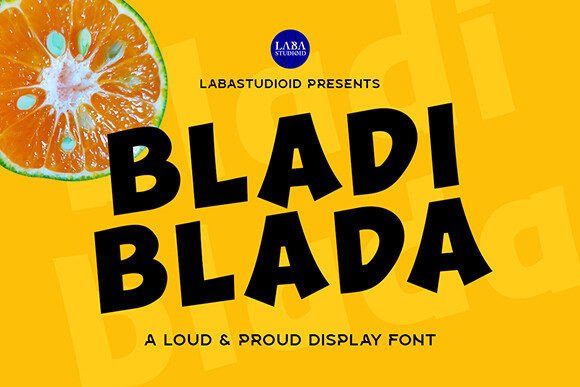
Bladiblada is a modern sans serif typeface built for clarity and presence—not flash, not fuss, but confident legibility at every size. Its letterforms are balanced and open, with generous counters and consistent stroke contrast that keeps it feeling warm, not clinical. There’s a subtle rhythm to its spacing—neither tight nor loose—that makes even short phrases breathe on packaging, cards, or digital previews. It doesn’t shout. It settles in, cleanly and calmly, like well-placed stitching on a linen tote bag.
I first tested Bladiblada on a batch of seasonal greeting cards—simple folded A6 sheets with pressed botanicals. Using it for the sentiment (“Warmest Wishes This Season”) gave the text a grounded elegance. No script needed. No extra flourishes. Just clean, intentional typography that let the handmade texture of the paper shine through. When printed, the letters held their shape crisply—even at 10pt on a small tag—and cut beautifully on my Cricut Maker, with no jagged edges or thin strokes collapsing during weeding.
That same reliability carried over to other formats: wedding invitation suites (where Bladiblada worked perfectly for names, dates, and venue details), printable wall art (its even weight scaled smoothly from 24pt headlines to 14pt care instructions), and boutique product tags (a single word like “Hand-Stamped” or “Small Batch” looked polished and intentional). Because Bladiblada is designed as a display font *and* a functional sans serif, it bridges the gap between visual impact and readability—especially important when your customer is scanning a shelf, flipping through a digital listing, or holding a physical card in natural light.
For packaging—like kraft boxes, sticker seals, or reusable cotton bags—Bladiblada adds instant cohesion. Its neutral yet distinctive character supports brand consistency without demanding attention. You’re not selling a font; you’re reinforcing a feeling: thoughtful, unhurried, quietly refined. And because it’s highly legible at small sizes, it performs just as well on ¾-inch shipping labels or 1.5-inch iron-on transfers for tote bags as it does on an 18x24” farmhouse-style sign.
It pairs effortlessly with other design assets, too. Try Bladiblada with a soft serif (like a gentle Garamond or Lora) for body text in invitations or digital templates—creating hierarchy without contrast overload. Or layer it under a delicate handwritten font for a greeting card headline (“You’re Invited”) where Bladiblada anchors the layout while the script adds personality. For planner pages or printable bundles, it holds up beautifully alongside simple icons or subtle line art, never competing, always supporting.
Before adding Bladiblada to your shop files or physical products, take a quick look at what’s included. Most versions offer multiple weights—Light, Regular, Medium, Bold—so you can adjust emphasis without switching families. Check for true italics (not slanted), OpenType features like ligatures or stylistic alternates (great for customizing “&” or initial caps), and multilingual support if you serve international customers. File formats matter, too: TTF and OTF work reliably across design apps and cutting software, while WOFF/WOFF2 are ideal if you ever build a shop website or digital preview page.
Licensing is non-negotiable. Bladiblada is a commercial font—meaning you’re free to use it on physical goods (candles, mugs, shirts), digital downloads (PDF planners, Canva templates), and social media graphics—but always verify the license covers your intended use. Some licenses restrict resale of SVG files or embedding in editable templates; others allow full commercial use with attribution waived. A quick read saves headaches later—especially if you’re bundling fonts into editable Canva templates or offering layered PSD mockups.
I’ve used Bladiblada on everything from holiday gift tags (with gold foil accents—its clean lines hold metallic ink beautifully) to digital sticker sheets (where crisp vector rendering means no pixelation, even when zoomed in on Etsy listings). It also shines in seasonal contexts: “Pumpkin Spice & Quiet Evenings” on an autumn mug design, “Spring Gatherings” on a floral welcome board, or “Made With Love” stitched onto a fabric label preview image. In each case, the font doesn’t distract—it deepens the mood.
Readability isn’t just about eyesight—it’s about trust. When text is easy to parse at a glance, customers feel confident in your craftsmanship. Bladiblada’s precise spacing and high x-height mean less squinting on tiny stickers, fewer mis-cuts on vinyl decals, and smoother rendering in low-res listing thumbnails. That matters whether you’re prepping a mockup for Instagram, uploading a PDF printable, or printing 500 hang tags for a wholesale order.
It’s not a “one-size-fits-all” decorative font—Bladiblada isn’t meant for long paragraphs of blog copy or dense instruction manuals. But for the moments that define your handmade brand—the name on your jar, the title on your printable, the phrase on your tote—it delivers clarity, calm, and quiet confidence. It’s the kind of font that feels like a natural extension of your process: deliberate, human-scaled, and unapologetically clear.
So next time you’re choosing type for your next batch—whether it’s candle labels drying on your desk, a stack of blank cards waiting for ink, or a fresh folder of digital templates—you might find yourself reaching for Bladiblada. Not because it’s trendy, but because it works. Softly. Strongly. Seamlessly.